For decades, premium travel was largely defined by what happened after a reservation was confirmed: the cabin, the suite, the transfer and the welcome on arrival. That definition is changing.
Today, the most valuable part of a journey often takes place before departure. It is the ability to identify a new rule early, understand how it affects the traveller's complete itinerary and prevent a disruption before it reaches the airport.
Several developments in early November illustrate this shift. Together, they point to a new reality for private clients, companies and institutional travellers connected to the Democratic Republic of the Congo: access itself has become part of the luxury experience.
The itinerary now begins before the booking
The clearest example is the temporary United States public-health order that took effect at 11:59 p.m. EST on 3 November 2026.
Under the order, every person boarding an international flight into or through the United States must attest that they have not been present in the DRC during the preceding 21 days, unless a specific United States government exemption applies. The measure covers commercial and private aircraft, passengers and crew. Presence includes transit through a Congolese airport, even without disembarking.
In practical terms, a person who has recently been in the DRC generally cannot board a United States-bound flight until Day 22. The order is currently scheduled to remain in effect until 18 December 2026, unless it is amended, extended or withdrawn earlier. The United States Centers for Disease Control and Prevention describes it as a temporary measure associated with the Ebola response and states that the overall risk to the American public and travellers remains low. For the wider context, see our earlier note on how the 2026 Ebola response is affecting travel from the DRC.
This is not simply another document to add at check-in. It changes whether a journey is legally possible. A confirmed seat, a valid visa or a private aircraft does not override the restriction.
The broader lesson is important: international itinerary design can no longer begin with availability alone. It must begin with travel history, transit points, entry eligibility and the rules applying at the time of boarding.
Digital borders can reduce friction—but they do not remove responsibility
South Africa is moving in the opposite direction: using technology to make legitimate travel faster and more predictable.
Its Electronic Travel Authorisation system combines digital applications, passport verification, facial biometrics and automated risk assessment. The official platform supports individual and group applications and is initially available to eligible travellers arriving through OR Tambo, Cape Town, King Shaka and Lanseria international airports. South African government statements indicate that the system had expanded to 53 countries by October 2026. A country list published by the South African Embassy in Caracas on 19 October includes the DRC; because implementation is phased, travellers should still confirm their eligibility directly through the official portal before relying on it.
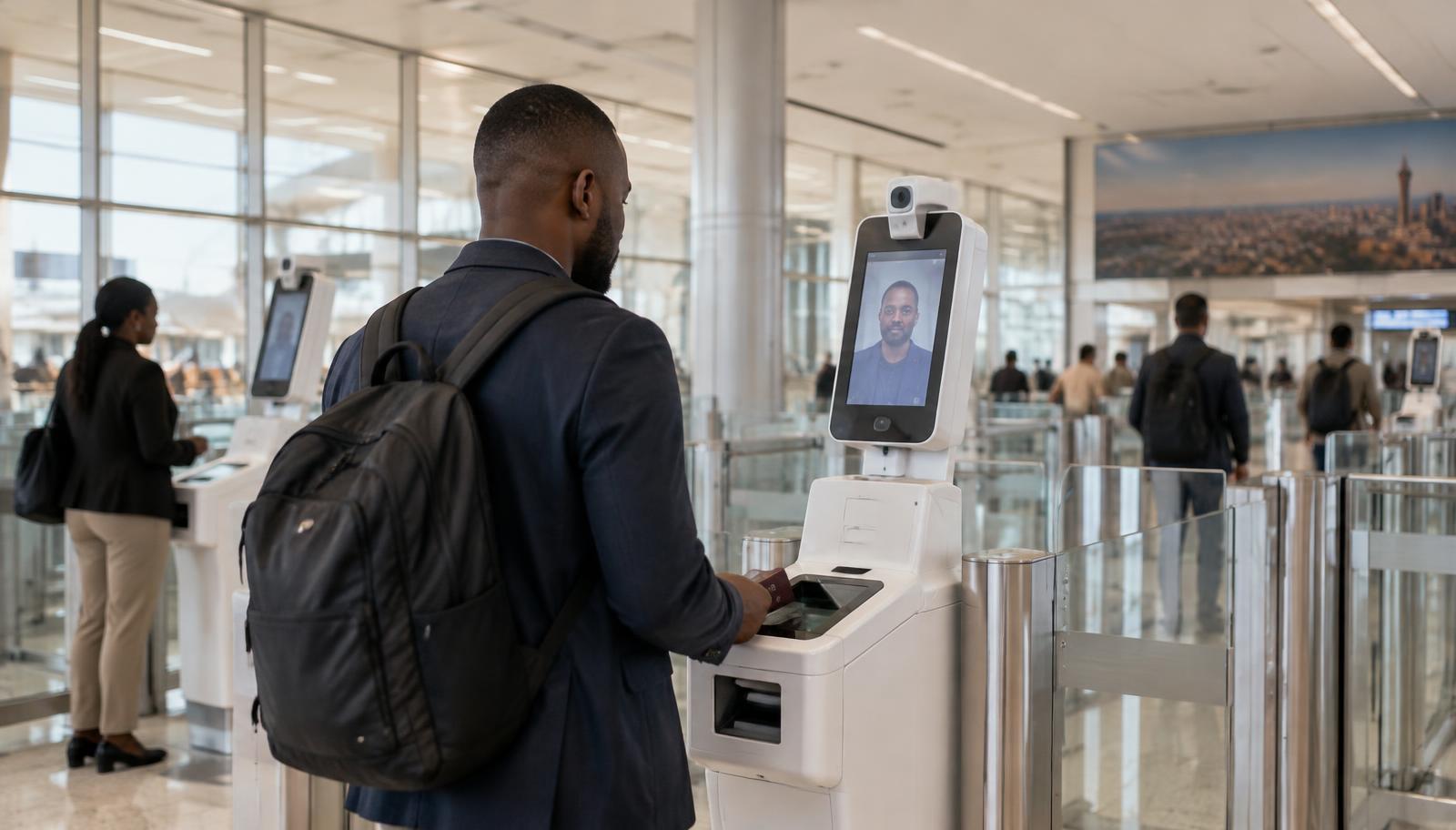
The development is especially relevant to family travel, corporate delegations and frequent regional movement. A more digital process can remove unnecessary visits and shorten administrative timelines. It does not, however, eliminate the need for accurate documentation, correct journey purpose or final border approval. An electronic authorisation is not permission to work, nor is it a guarantee of admission.
For the premium traveller, digital convenience is therefore only one part of the experience. The other is informed preparation: ensuring that the authorisation, passport, itinerary and declared purpose remain consistent from application to arrival. Our Africa Mobility Index tracks how far African passports travel without a visa, and where planning is still required.
Reliability must be verified, not assumed
The DRC's domestic aviation environment is also entering a period of closer regulatory scrutiny.
On 7 November, the Agence Congolaise de Presse reported that the Civil Aviation Authority had granted operators a one-month moratorium to regularise services to stops not listed on their Air Operator Certificates. Flights were permitted to continue during the moratorium while operators addressed the requirements.

The confirmed fact is the compliance period. The possible effect on particular routes after that period is not yet confirmed and will depend on whether individual operators regularise their authorisations. Nevertheless, the development reinforces a basic principle: the existence of a published route or previous service is not, by itself, sufficient evidence of future operational continuity.
For private and corporate travellers, reliability increasingly depends on current verification, realistic connection times and sensible contingency planning. In complex markets, seamlessness is not the absence of change; it is the ability to absorb change without transferring disorder to the client.
Artificial intelligence will accelerate service—but trust will remain human
The same principle applies beyond aviation.
On 4 November, CrediMax and Mastercard announced an initiative in Bahrain to explore AI-assisted commerce across product discovery, selection, payment and post-purchase support. The following day, Visa published a benchmark of 22 AI models performing realistic shopping tasks. The models failed 42.8% of test runs, and 54% of failed runs still resulted in a purchase.
The direction of travel is clear: AI will increasingly help consumers identify options, compare services and initiate transactions. The present limitation is equally clear: speed is not the same as judgement.

In travel and lifestyle management, an incorrect purchase can have consequences far beyond an unsuitable product. It can create a missed connection, an unusable reservation, an immigration issue or a breach of a client's stated preferences. Technology can improve research and responsiveness, but discretion, accountability and informed client consent remain essential.
For a premium service provider, the strongest model is therefore not technology versus people. It is technology governed by people—combining faster information processing with human responsibility at the moments that carry financial, legal or personal consequences.
A new definition of seamless service
These developments may appear unrelated: a temporary United States travel restriction, a South African digital border platform, aviation compliance in the DRC and the rise of AI-assisted commerce. In reality, they describe the same transition.
Premium mobility is becoming a coordinated discipline of access, compliance, timing, technology and judgement. The visible elements of a journey will always matter, but the true measure of service is increasingly what the client never has to experience: the denied boarding, the invalid document, the unreliable connection or the automated purchase that should never have been made.
At Mansa Legacy Group, we believe the future of private and institutional service will be defined by informed anticipation, discreet coordination and accountable human care. Luxury is no longer only what surrounds the traveller. It is the confidence that every essential detail has been considered before the journey begins. Discover how our travel and concierge teams prepare each journey, or request access.
This article is provided for general information only and does not constitute legal, immigration, medical or public-health advice. Requirements may change without notice. Travellers should verify current rules with the relevant government authority and operating carrier before departure. Mansa Legacy Group does not guarantee visa issuance, travel authorisation or admission by a border authority, and no affiliation or endorsement by the organisations cited below is implied.
Direct sources
- U.S. CDC — Requirement for Attestation by All Persons Traveling by Air to the United States
- U.S. Federal Register — Amended Attestation Order
- Government of South Africa — Launch of the Electronic Travel Authorisation
- South African Department of Home Affairs — Official ETA Portal
- South African Embassy in Caracas — Countries Currently Live on the ETA Platform
- Agence Congolaise de Presse — Aviation Compliance Moratorium
- Mastercard — CrediMax Collaboration on Agentic Commerce
- Visa — Agentic Commerce Benchmark
Mansa Legacy Group — Get better at living.